From Maryland to North Carolina
John Puckham (1660)1 -> Richard (1690)2 -> Richard (abt. 1725)3 -> George Bookram (1766)4 -> Elias (1790)5 -> Delia (1829)6 -> Nancy Elizabeth Taborn (1864)7 -> William Braswell (1883)8 -> Buddy (1920)9 -> Clara Mae (1953)10 -> Marleena Thomas (1994) 11 -> Rayden Brown & D’Mar Love 12
The earliest recorded member of this family was John Puckham, born about 1660. John was a Native American who married Joan Johnson, a Black woman and granddaughter of Anthony Johnson, one of the earliest documented free Black landowners in colonial Virginia.
John Puckham was baptized on January 25, 1682/83, by Reverend John Huett in Stepney Parish, Somerset County, Maryland. He married Joan Johnson on February 25, 1682/83, with the marriage performed by the same minister. Since John was baptized only a month before his marriage, it is possible that he received his Christian name at that time, although this cannot be established from the surviving record.
John may have originated in the Native American settlement of Monie, near the Wicomico River. Another theory suggests that the surname Puckham was derived from Puckamee, a Nanticoke Indian village in northern Somerset County, Maryland. These possibilities have been discussed by historians, but neither has been conclusively established.
Much of what is known about the early Puckham family comes from Free African Americans of Maryland and Delaware, particularly pages 292–295, in the section titled “Puckham Family.” This genealogical study draws on surviving church registers, county court proceedings, tax lists, land records, and census records. Among the important sources are the Stepney Parish records, Somerset County Judicial Records, and eighteenth-century tax assessments from Maryland and Delaware.
Tracing the exact line of descent is challenging. The family name appears in several forms, including Puckham, Puckram, Puckman, and Bookram. Although the surname was relatively uncommon, enough historical documents have survived to reconstruct several generations of the family. Some relationships are firmly documented, while others represent the most likely connections based on names, dates, locations, and surviving records.
The following is the most likely reconstruction of the family line leading to Elias Bookram. The earlier generations lived in Maryland, while branches of the family moved into Delaware during the eighteenth century. Elias Bookram subsequently settled in Granville County, North Carolina, during the late eighteenth or early nineteenth century.
The Family Line
1. John Puckham (born c. 1660) and Joan Johnson
John Puckham is the eighth great-grandfather of Rayden Brown and D’Mar Love on their mother’s side of the family, according to the proposed family lineage.
John and Joan married in Somerset County, Maryland, in February 1682/83. Their marriage is particularly significant because contemporary church records identify John as an Indian and Joan as a Black woman. The family therefore has documented Native American and African ancestry dating to the seventeenth century.
John apparently died before June 1699, when Joan arranged for two of their sons to be apprenticed.
Their known or probable children included:
- Abraham Puckham, born about 1685.
- John Puckham, born December 1, 1686.
- Susannah Puckham, born about 1688 (tentative identification).
- Richard Puckham, born March 10, 1690, through whom the proposed family line continues.
2. Richard Puckham (1690–before 1756?)
Richard was born on March 10, 1690, in Somerset County, Maryland. Following his father’s apparent death, his mother bound him as an apprentice to Benjamin Colman on June 13, 1699.
As an adult, Richard established his own household in Somerset County. Tax records place him in Wicomico Hundred between 1727 and 1734, Manokin Hundred in 1736, and Monie Hundred in 1738 and 1739.
Between 1744 and 1754, several younger Puckham men appeared in his household, including John, Richard, Matthew, Solomon, and David. These men were probably his sons.
Richard likely died before 1756, when members of the family appeared in the household of Mary Puckham, who may have been his widow or daughter.
The proposed ancestral line continues through his son:
Richard Puckham, born about 1725.
3. Richard Puckham (born c. 1725) and Ann
Richard Puckham was born about 1725 and grew up in Somerset County, Maryland. He appeared in tax records beginning in 1743 and eventually established his own household.
In 1762, he received a patent for 192 acres of land in Somerset County. Subsequent records show that he owned property, traded livestock, and participated in land and financial transactions.
His wife was named Ann, as documented in a mortgage dated February 28, 1769, involving 117 acres of their land.
By 1774, Richard had moved to Broadkill Hundred, Sussex County, Delaware. His brother Matthew also appears in Delaware records during this period.
Richard may have been the father of four men who appeared in Maryland and Delaware records during the late eighteenth century:
- George Puckham (Bookram), born about 1766.
- Levin Puckham (Puckman), born about 1768.
- Ephraim Puckham, born about 1769.
- John Puckham (Puckman), born about 1770.
The relationship between Richard and these four men is considered probable rather than conclusively documented. Their ages, geographic movements, and appearances in tax records support the proposed connection.
Of these men, George Puckham is the most likely candidate to have been the father of Elias Bookram.
4. George Bookram / Puckham (born c. 1766)
George Puckham, whose surname may also have appeared as Bookram or Puckram, was born about 1766, probably in Maryland.
He appeared in tax records for Little Creek Hundred, Kent County, Delaware, in 1788 and 1789.
By 1800, George had returned to Somerset County, Maryland, where he was recorded as the head of a household in Wicomico Hundred. The 1800 census listed five people in his household under the category “other free.”
In 1820, his household was recorded as containing five individuals classified as “free colored.”
These census designations were used for free people who were not classified as white and are consistent with the family’s earlier documented Native American and African ancestry.
George is the most likely father of Elias Bookram, born about 1790. However, a direct document establishing this father-son relationship has not yet been identified. The proposed connection is based on the chronology, geography, and possible variations in the family surname.
5. Elias Bookram (c. 1790–1860)
Elias Bookram was born about 1790 in Maryland, probably into the extended Puckham family.
At some point during the late eighteenth or early nineteenth century, Elias moved south to North Carolina, settling in the Granville County area.
The movement from Maryland to North Carolina represents an important transition in the family’s history. Earlier generations had lived primarily on Maryland’s Eastern Shore and in neighboring Delaware, while Elias established a new branch of the family farther south. The connection between Elias and George Bookram remains the most likely reconstruction of the ancestral line, but additional records would be needed to confirm it definitively.
Elias married Chashe (Chasey) Scott as his second wife on June 24, 1824. On June 24, 1824, Elias Puckham (Bookram) applied for a marriage license to marry Chasey Scott in North Carolina. The surviving marriage bond names Moses Jones as his bondsman and Gabriel Holmes as governor. Elias and Moses jointly pledged a bond of five hundred pounds, a customary legal guarantee that no lawful impediment existed to the proposed marriage. The amount was not a marriage fee and ordinarily would not have been paid unless the conditions of the bond were violated.
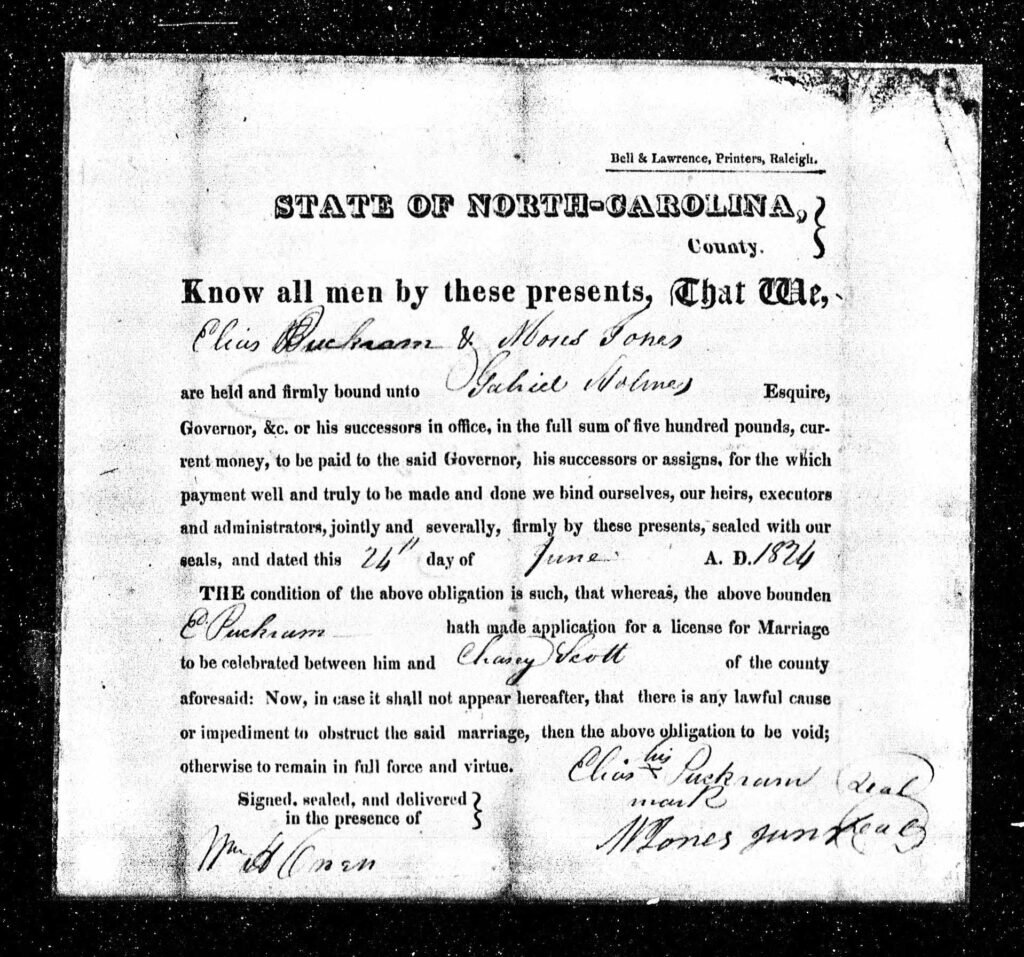
The document is particularly valuable because it provides contemporary evidence of Elias’s name, his intended marriage to Chasy Scott, and his association with Moses Jones. Elias signed the bond by making his mark, a common practice among individuals who did not sign their names.
Source: North Carolina marriage bond for Elias Puckham and Chasy Scott, dated June 24, 1824; original historical document.
Elias and his first wife are likely the parents of three sons:
- Walter Bookram (1810–1893)
- William Bookram (1812–?)
- Gavin Bookram (1815– ?)
Elias and Chashe had at least 10 children
- Emmaline Bookram (1826–1897)
- Sally Bookram (1827–1855_
- Delia “Dilley” Bookram (1829–1920)
- Alfred Bookrum (1833–?)
- Betsy Puckram (1834–1900)
- Solomon Bookram (1836–1872)
- Nancy Bookrum (1837– ?)
- Rena Bookrum (1840–1897)
- Frances Bookrum (1842– ?)
- Mary Bookram (1843–1880)
6. Delia “Dilley” Bookram (c. 1829-1920)
Delia Bookram was born in 1829. She later met and married Paul Taborn (Tabone) in Granville North Carolina. They married in 15 Feb 1854 in Granville, North Carolina, USA. See the Taborn Family page for more about this family.
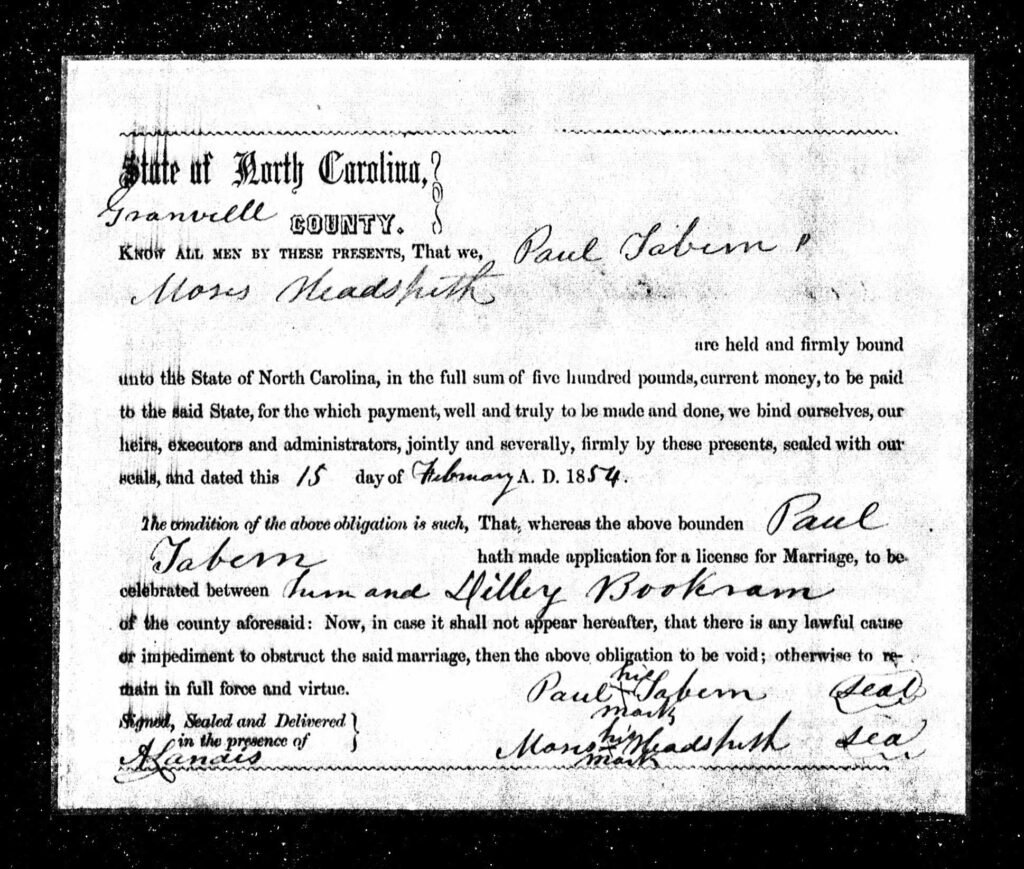
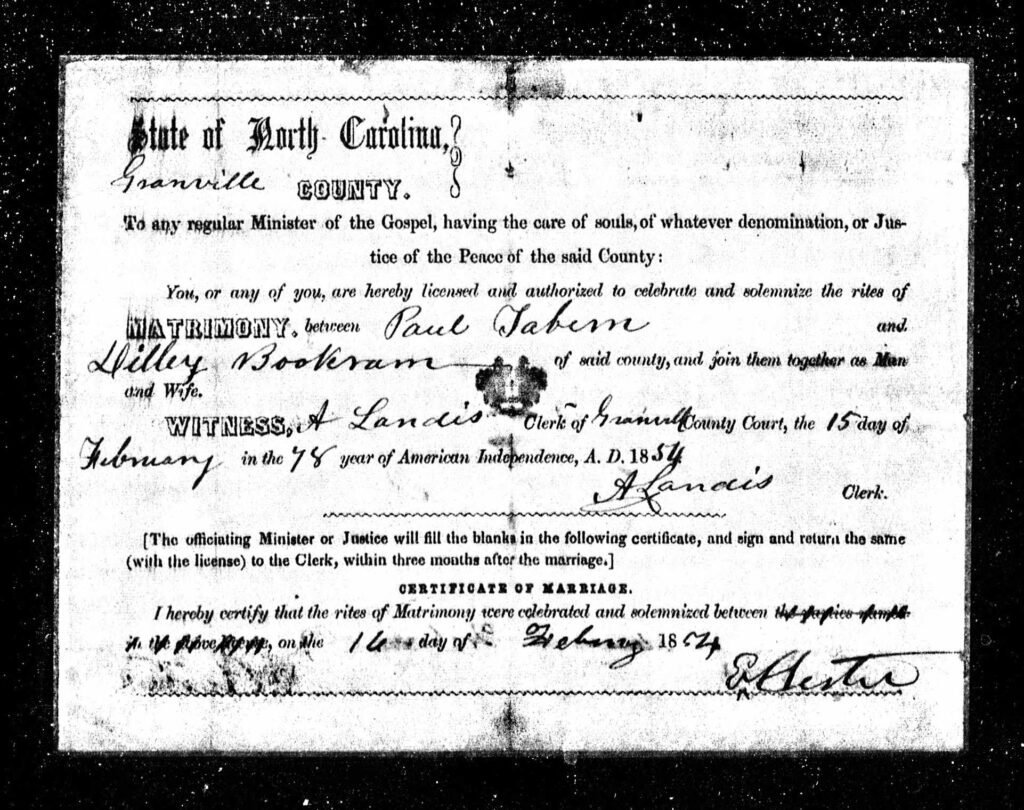
The couple settled in Granville and had several children:
- Chany Ann “Chasa” Taborn (1855– ?) Also called Chasey, this daughter appears in the 1860 and 1870 census records. She marries first a man named King Jenkins on the 22nd June 1876. At age 29, on the 17th December 1882 she married, for a second time, a man named Edward Harris in Wake, North Carolina.
- Solomon Tabourn (1856–1930) Marries Reeda Nihols on 30th Dec 1875 in Wake, North Carolina. In 1910 SOlomon and his family appear in the census. His wife is called Morella and they are said to have been married 30 years. Solomon is 53 and described as a Mulatto. He is a farmer and owned his own farm. He had owned the property free of mortgage for 7 years at that time. Solomon died in 1930 of kidney disease. He was about 65 years old.
- Jane Taborn (1857–?) Jane is mentioned as the youngest in the family at 3 years old in 1860. In 1870 Jane is not mentioned. Her younger sister Jeney was mentioned, so it is possible Jane died and that her sister was named after her.
- Lucinda Tabourn (1859–?) Lucinda shows up as an 11 year old girl in the 1870 census.
- Larotha “Loetta” Taborn (1861–?) Luetta Taborn married John E. Evans on the 6th of February 1883 in Granville, North Carolina
- Jennie “Jeney” Taborn (1863–1929) An announcement in the newpaper indicates that in June 1880 Jennie Taborn intended to marry a man named George Allen.
- Press Tabourn (1864–?) In 1880 Press lives at home with her parents and sisters Loetta and Nancy. It is not clear what happened to her after 1880.
- Nancy E Tabone (1864–1905) Married Alexander Braswell (see next family entry)
- Jacob Tabourn (1865–?) Jacob is listed in the 1870 census, but not in 1880 indicating he likely died young.
7. Nancy E. Taborn (c. 1864-1905)
Nancy was born in 1864, the daughter of Paul Taborn and Delia Bookram. She came from a big family with 6 sisters and 2 brothers. Nancy married the much older Alex Bazel (Alexander Braswell) on 8th Sep 1883. Nancy was 22 and her husband is listed on the certificate as 35 (or 38) but may have been even older. Alexander had been married before and was a widower with a young daughter at the time of the marriage. Alex and Nancy would have three children of their own.
- William Braswell (1883–1935)
- Bettie Braswell (1886–1936)
- Walter Broswell (1889–?)
The Braswell family has a separate page dedicated to their family where you can read more about Alex and Nancy’s story (see Braswell Family Page)
Historical Context
The history of the Puckham–Bookram family is significant because it documents a free family of Native American and African ancestry living in colonial Maryland as early as the seventeenth century.
Over successive generations, members of the family worked as farmers, carpenters, and landowners. Some acquired substantial property, while others appear in records involving apprenticeships, labor arrangements, and court proceedings.
The family’s movement between Maryland and Delaware, followed by the migration of Elias Bookram to North Carolina, reflects the broader geographic movement of free families of color during the eighteenth and early nineteenth centuries.
The surviving records also demonstrate the difficulties of tracing families whose names were recorded inconsistently and whose racial classifications changed over time. Nevertheless, church records, tax lists, land transactions, and census returns provide a substantial documentary foundation for reconstructing the family’s history.
Sources and Documentation
The principal published source for the early generations is:
Paul Heinegg, Free African Americans of Maryland and Delaware, pp. 292–295, “Puckham Family.”
Return to the Love-Thomas main page